IT Audit for Businesses
Know the real state of your company's technology before a failure turns into downtime, data loss or a security incident.
Strong Answer assesses your organisation's systems, equipment, networks, access, cloud services, backups and security controls.
We identify technical and operational risks, gather evidence, and present a clear action plan, prioritised and matched to the reality of your business.
- Over 25 years of experience
- Remote and on-site auditing
- Executive report and technical report
- Prioritised improvement plan
- Support across the whole country
- Multidisciplinary IT and cybersecurity team
Do you really know what state your systems are in?
Many companies use equipment, applications and cloud services every day without a complete view of the risks involved.
An infrastructure can look operational and still have critical problems:
- Former employees' accounts still active
- Users with more permissions than they need
- Passwords shared between staff
- Equipment and operating systems out of support
- Backups configured but never tested
- Networks without proper segmentation
- Remote access without sufficient protection
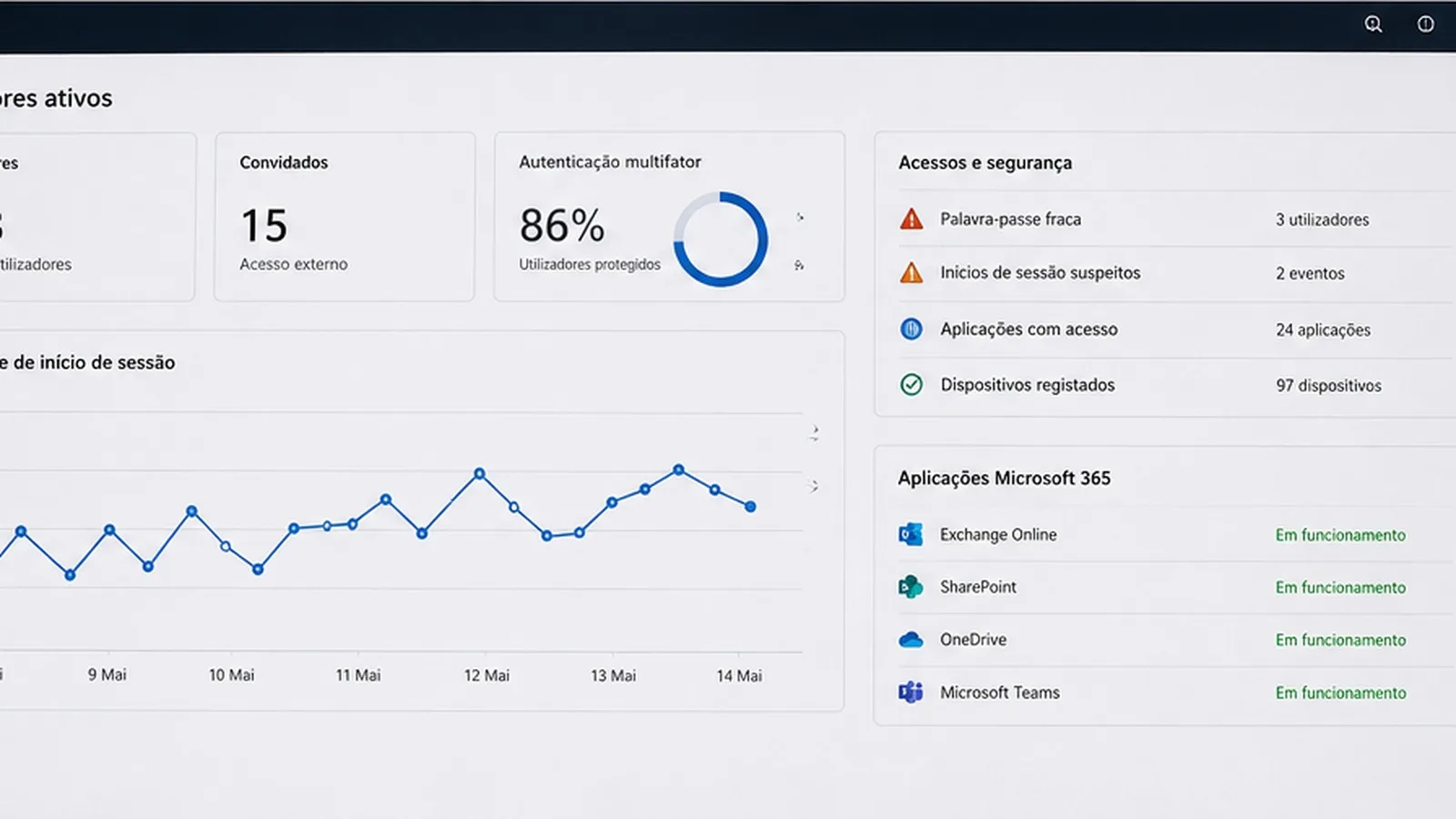
- Microsoft 365 without multi-factor authentication
- Software installed without licence control
- Servers without monitoring or maintenance
- No technical documentation
- Excessive dependence on one person or supplier
- No recovery plan in the event of an incident
An IT audit replaces assumptions with evidence and well-founded decisions.
What is an IT audit?
An IT audit is a structured assessment of an organisation's information systems, technology infrastructure and the controls it has in place.
The aim is to determine whether the technology the company uses is:
- Secure
- Suited to the needs of the business
- Reliable
- Up to date
- Efficient
- Recoverable in the event of failure
- Managed in a controlled way
- Compatible with the requirements that apply to the organisation
It is not simply a matter of checking that the equipment is switched on or that the programs run.
The audit examines whether the existing controls are sufficient, whether they are correctly configured, and whether they work in practice.
Audit, diagnosis, vulnerability assessment or penetration test?
Each service has a different objective.
| Service | Objective | Result |
|---|---|---|
| Technical diagnosis | Identify the cause of a specific problem | A fix or a technical recommendation |
| IT audit | Assess systems, controls and risks as a whole | Report, risks and action plan |
| Vulnerability assessment | Identify known technical vulnerabilities | Technical list of vulnerabilities |
| Penetration test | Simulate authorised attacks within a defined scope | Exploitable vulnerabilities and impact |
| IT consultancy | Define a strategy, architecture or technology plan | Recommendations and implementation plan |
An audit may include vulnerability assessments, but it does not automatically replace a penetration test.
Offensive testing is carried out only when it has been contracted, authorised and formally scoped.
When should you carry out an IT audit?
An IT audit is recommended when:
- There is no up-to-date inventory of systems and equipment
- The company does not know who has access to its information
- The backups have never been tested
- Failures, slowdowns or interruptions happen frequently
- Several suppliers manage different parts of the infrastructure
- A change of IT supplier is planned
- The company is opening a new location
- An acquisition, merger or expansion is under way
- Suspicious activity has been identified
- A security incident has occurred
- There are doubts about compliance with internal policies
- The organisation wants to improve its cybersecurity maturity
- A certification or external assessment needs to be prepared
- Management needs to know what technology investment is required
- The company depends on legacy or custom-built systems
- There is no documentation on networks, servers, access or backups
An audit can also be carried out preventively, without any incident having taken place.
What we assess
The scope is defined according to the size, activity, infrastructure and objectives of the organisation.
We identify and validate the main IT assets:
- Desktops and laptops
- Physical and virtual servers
- Network equipment
- Firewalls
- Printers and peripherals
- Mobile devices
- Storage systems
- Virtual machines
- Business applications
- Domains and hosting services
- Cloud services
- Licences and subscriptions
- Equipment out of warranty or support
The inventory shows what exists, who uses each resource, and which assets support critical processes.
Types of audit
General systems and infrastructure audit
An overall assessment of the technology infrastructure, equipment, network, servers, access, software, documentation and operation.
For companies that want to know the general state of their technology.
Cybersecurity audit
An assessment focused on security risks, endpoint protection, access, network, cloud, email, updates, vulnerabilities and incident response.
For organisations that want to reduce their exposure to cyberattacks.
Microsoft 365 and cloud audit
An assessment of accounts, permissions, authentication, external sharing, email, connected applications, logs, retention and security policies.
For companies using Microsoft 365, Google Workspace or other cloud services.
Backup and continuity audit
An assessment of policies, systems, retention, monitoring and actual recovery capability.
For when backups have never been tested, or when business continuity depends on critical data and applications.
Access and identity audit
A review of accounts, permissions, administrative privileges, multi-factor authentication and the processes for onboarding, role changes and offboarding.
For companies with several users, roles and levels of access.
Audit before changing supplier
A record of the current state of the infrastructure, access, contracts, licences, documentation, backups and dependencies.
Lets you move between suppliers with more control and less operational risk.
Audit for new sites or expansion
An assessment of the existing infrastructure and the definition of requirements for networks, equipment, cloud, security, communications and continuity.
For before opening a new location or growing the team.
Compliance-readiness audit
A technical assessment against an agreed framework or set of requirements. It can support work related to ISO/IEC 27001, the NIST Cybersecurity Framework, CIS Controls, the GDPR, or specific client and partner requirements.
This type of audit does not, in itself, constitute an official certification.
How we carry out the audit
01
Initial meeting
We start by understanding:
- What the company does
- The main concerns
- The critical systems
- The number of users
- The existing locations
- The cloud services in use
- Any known incidents
- The objectives of the audit
02
Defining the scope
Before work begins, we set out in writing:
- Systems included
- Systems excluded
- Locations
- Period under analysis
- Access required
- Restrictions
- Authorised testing
- Deliverables
- Schedule
- Points of contact
Setting this out avoids differing interpretations and makes sure the audit answers the company's objectives.
03
Gathering information
We collect the relevant documentation and technical information:
- Inventories
- Diagrams
- Contracts
- Policies
- User lists
- Configurations
- Logs
- Reports
- Backup information
- Licensing
- Internal procedures
04
Technical assessment
The team analyses the configurations, controls and systems within scope. Wherever possible, the findings are supported by verifiable evidence, such as:
- Configuration exports
- Platform reports
- Activity logs
- Test results
- Inventories
- Technical screenshots
- Documentary confirmations
- Functional checks
05
Risk assessment
Each problem identified is assessed against factors such as:
- Likelihood of occurrence
- Impact on the business
- Systems affected
- Exposure
- Ease of exploitation
- Existence of compensating controls
- Complexity of the fix
- Urgency
06
Preparing the report
The findings are organised so they are understandable to management and detailed enough for the technical team.
07
Presenting the results
We hold a presentation meeting to:
- Explain the main findings
- Clarify the risks
- Identify immediate actions
- Set priorities
- Support the preparation of the improvement plan
08
Verifying the fixes
When contracted, we carry out a follow-up review to confirm that the measures have been implemented and that the risks have genuinely been reduced.
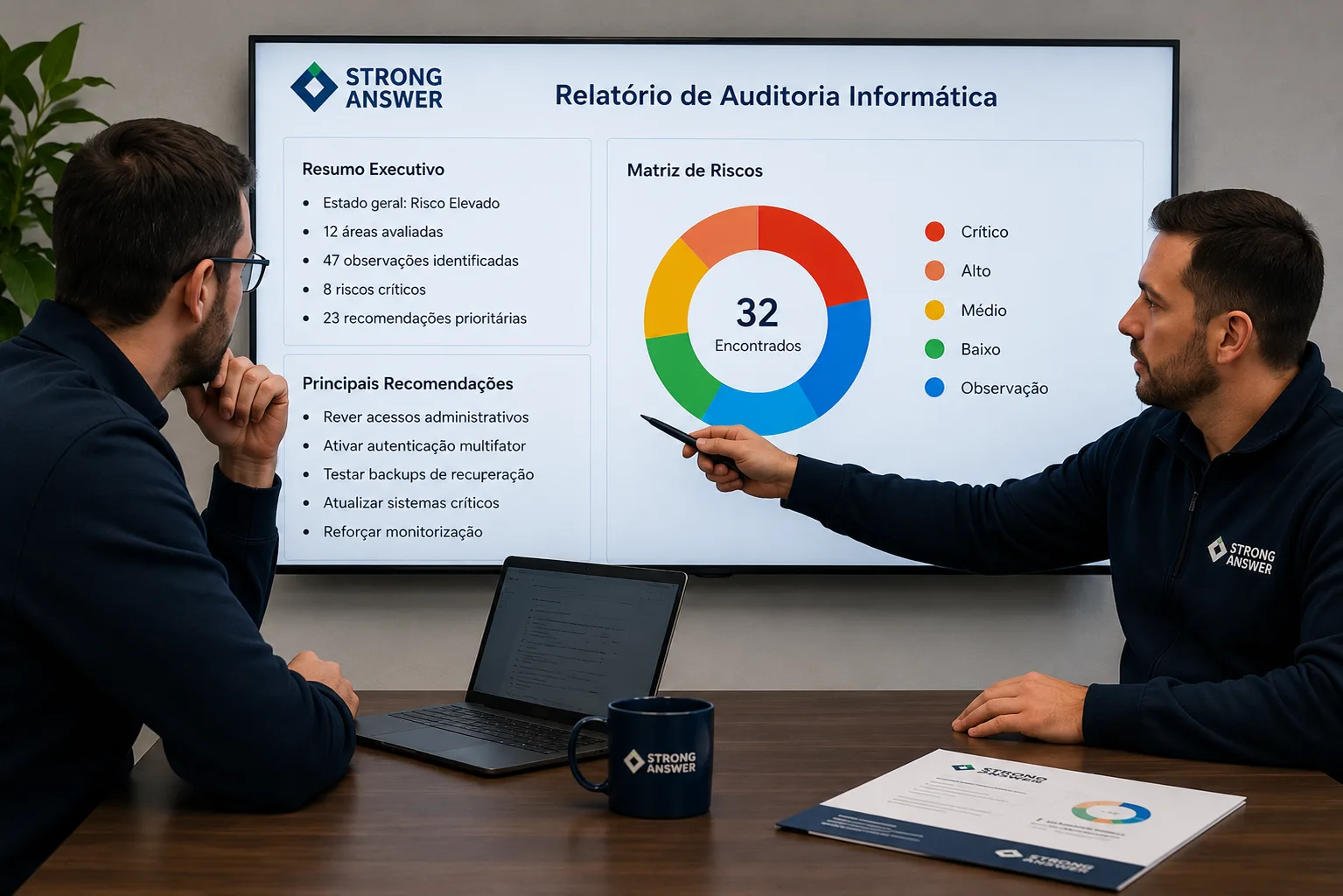
How we classify risks
Critical
There is a high likelihood of serious or immediate impact on the business, the systems or the information.
Requires urgent action.
High
The problem could cause a significant incident, an interruption, data loss or unauthorised access.
Should be fixed as a priority.
Medium
The risk is significant, but there are limits to how it can be exploited, or controls that partly reduce the impact.
Should be built into the improvement plan.
Low
The expected impact is limited, or it is mainly an opportunity to reinforce good practice.
Should be tracked and fixed in a planned way.
Observation
Not necessarily a vulnerability, but an opportunity for improvement, documentation or optimisation.
The final classification always takes the organisation's specific context into account. The same problem can represent different levels of risk in different companies.
What you receive at the end of the audit
Executive summary
A document for the board and the business owners, covering:
- General state of the systems
- Main risks
- Potential impact
- Priorities
- Recommended decisions
Technical report
A detailed description of the problems identified, including:
- System or process affected
- Evidence
- Risk
- Impact
- Recommendation
- Priority
- Estimated complexity of the fix
Risk matrix
A consolidated view of the findings, classified by criticality, area and priority.
Validated inventory
When included in the scope, we deliver a record of the main assets, systems, services and dependencies identified.
Action plan
A plan organised by priority, which may include:
- Immediate measures
- Short-term actions
- Structural improvements
- Owners
- Dependencies
- Completion criteria
Modernisation roadmap
Where applicable, we present a phased proposal to:
- Reduce risks
- Update equipment
- Consolidate services
- Improve security
- Increase availability
- Control costs
- Prepare for the organisation's growth
Presentation meeting
The Strong Answer team presents the results and explains the technical and business implications of each priority.
A report that leads to concrete action
The audit does not end with a generic list of problems. Every finding should answer five questions:
- 1What was identified?
- 2What evidence supports the finding?
- 3What is the risk to the organisation?
- 4What should be done?
- 5How urgent is the fix?
The aim is to let management make well-founded decisions and to let the technical team know exactly where to start.
Frameworks used
Depending on the scope and objectives agreed, the audit may use the following as reference:
- ISO/IEC 27001
- ISO/IEC 27002
- NIST Cybersecurity Framework 2.0
- CIS Critical Security Controls
- The General Data Protection Regulation
- The organisation's internal policies
- Contractual requirements
- Manufacturers' good practice
- Sector-specific requirements
The applicable frameworks are agreed at the start of the project.
Using them as assessment criteria does not mean the organisation automatically becomes certified or legally compliant.
Independence, confidentiality and protection of information
During the audit, Strong Answer may have access to sensitive information about the organisation's infrastructure, systems and controls. For that reason:
- Access is limited to what is necessary
- The scope is authorised in advance
- Credentials must not be included in the report
- Evidence is handled under controlled conditions
- Results are shared only with the people identified
- Potentially intrusive testing requires specific authorisation
- Information retention periods can be set contractually
- Confidentiality agreements can be signed
The audit and the implementation of the fixes can be contracted separately.
Where Strong Answer also implements corrective measures, the recommendations, priorities and their costs are presented transparently.
Why choose Strong Answer?
Over 25 years of experience
We have followed the evolution of business technology and know the problems that affect organisations with old, modern or hybrid infrastructures.
A multidisciplinary view
Our team works across infrastructure, networks, cloud, technical support, cybersecurity, business software and development. That lets us analyse not just isolated components but the dependencies between systems.
Technical and business language
We present information detailed enough for the technical teams and clear enough for the board.
A practical approach
Our recommendations take into account the real risk, the size of the company, day-to-day operations, the available budget, urgency, and the internal capacity to implement them.
Remote and on-site support
We work remotely and at the client's premises, depending on the needs and the systems involved.
Continuity after the audit
Strong Answer can support the organisation in fixing the problems, modernising the infrastructure and monitoring it on an ongoing basis. Implementation is presented and contracted separately, so the client decides which actions to carry out.
How long does an IT audit take?
The duration depends on factors such as:
- Number of users
- Number of devices
- Number of servers
- Number of locations
- Complexity of the network
- Cloud services in use
- Whether documentation exists
- Depth of the analysis
- Whether site visits are needed
- Testing included in the scope
A limited assessment can be carried out in a few working days. A full audit across several locations may require more than one phase.
The schedule is presented after the initial meeting and the definition of the scope.
How much does an IT audit cost?
The investment is calculated according to the scope, size and complexity of the infrastructure. Before putting a proposal together, we seek to understand:
- What needs to be analysed
- How many systems are involved
- How deep the analysis should go
- Which deliverables are needed
- Whether additional testing will be carried out
- Whether a follow-up review is required
The proposal clearly identifies what is included, what is excluded, and which results will be delivered.
Frequently asked questions
Most checks can be carried out without interrupting operations. Any test that could affect systems or services is identified, authorised and scheduled in advance.
It depends on the scope. Where technical access is needed, temporary accounts, controlled credentials or supervised sessions should be used. How access is granted is agreed before work begins.
No. Access should be limited to the systems, configurations and evidence needed to fulfil the agreed scope.
Yes. The current supplier's cooperation can make it easier to gather documentation, access, inventories and information about the infrastructure. The audit must nonetheless keep an objective assessment of the evidence collected.
Yes. The audit can cover only the network, the backups, Microsoft 365, access, cybersecurity, a single location or a specific set of systems.
Only when it is expressly included in the proposal and in the authorisation document. A standard audit does not automatically involve exploiting vulnerabilities.
No. No audit or technical solution can eliminate every risk. The aim is to identify exposures, improve the controls, and reduce the likelihood and impact of incidents.
The audit can assess technical and organisational measures relating to data protection. It does not replace a full legal assessment, nor does it constitute an automatic guarantee of legal compliance.
Yes. After the audit, a separate proposal can be put forward to implement the measures approved by the client.
Yes, as long as the handling and distribution of the report respect the confidentiality rules agreed. An executive version without sensitive technical detail can also be prepared.
Yes. Repeating it allows results to be compared, fixes to be verified, the evolution of risks to be tracked, and the organisation's technological maturity to be measured. It can be annual, six-monthly, or adjusted to the risk and activity of the company.
Don't wait for a failure to discover the risks
An interruption, a cyberattack or a data loss can reveal problems that had already been there for months or years.
An IT audit lets you know those risks in advance and decide where to act first.
Tell us:
- How many users the company has
- How many locations there are
- Which systems you consider critical
- What your main concerns are
- Whether any incident has occurred
- Which area you want assessed
Request an IT audit
Fill in the essentials. Our team will get in touch to understand the context and define the scope of the audit.
Lagoa · Algarve
Monday – Friday
(09:00 – 13:00) — (14:00 – 19:00)